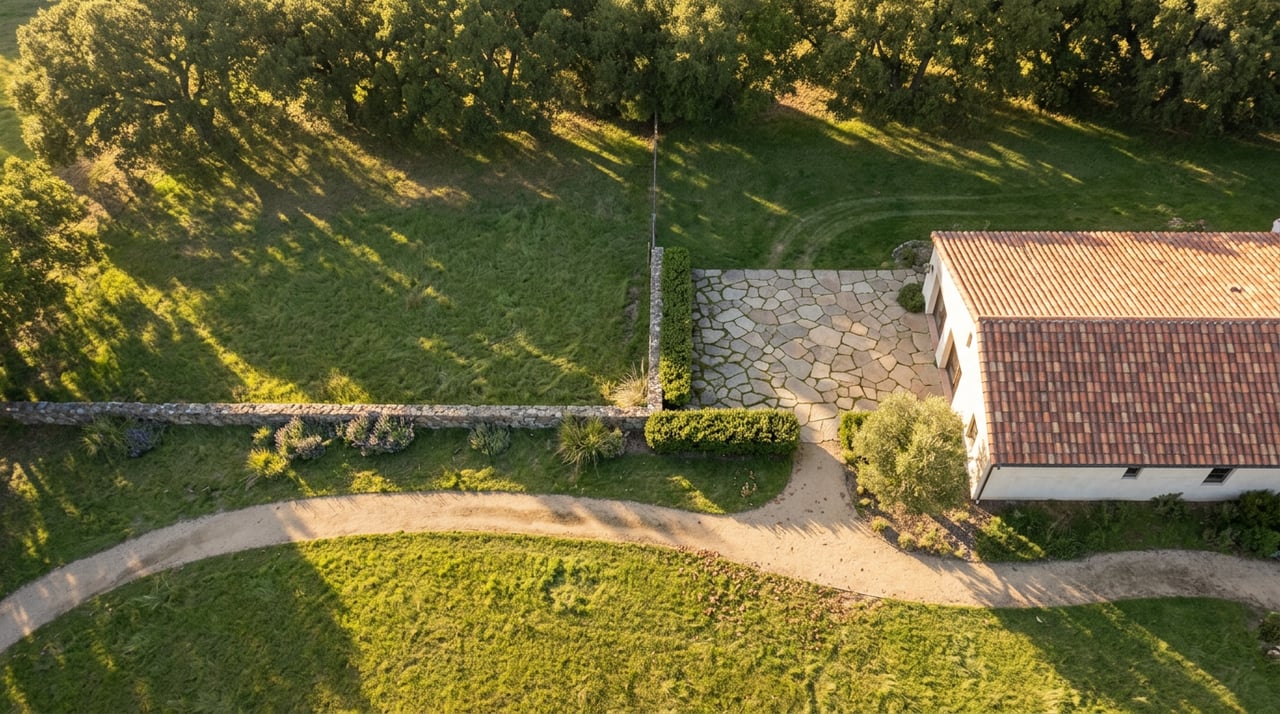
Say you're touring a 2.4-acre parcel off Ortega Highway. The listing calls it equestrian-zoned, the agent mentions trail access, and the math in your head is simple: more than two acres, plenty of room for a few horses, maybe even a small boarding setup for friends. Then you ask the seller how many horses they've actually kept there, and the answer is three. Not because of some HOA rule. Because most of the property sits on a slope, and the flat ground where a horse can actually stand doesn't come close to what the acreage implies.
This is the part of buying a horse property in San Juan Capistrano that rarely makes it into a listing description. The city's zoning code considers both lot size and flat, buildable land, and it draws hard lines at specific acreage thresholds that determine whether you need a conditional use permit or not. Two properties with identical lot sizes on paper can have completely different legal horse capacities, and the difference has nothing to do with square footage on a deed.
The Ordinance Math Nobody Reads Before Writing an Offer
San Juan Capistrano's equestrian standards, codified under Section 9-3.515 of the municipal code, set a general ratio of one horse per 10,000 square feet of lot size. But the section that actually governs most residential parcels is more specific than that ratio suggests. The first horse requires 2,500 square feet of lot area, and 500 of those square feet must be flat ground, defined as slope no greater than 10 percent. Each additional horse beyond the first requires another 500 square feet of that same flat land.
Then there's the permit threshold, which behaves less like a smooth scale and more like a series of cliffs:
| Lot size | Horses allowed without a conditional use permit |
|---|---|
| 2 acres or less | 4 |
| Between 2 and 5 acres | 6 |
| More than 5 acres | 10 |
Cross from 1.9 acres to 2.1 acres and you've unlocked two more horses without touching City Hall. Stay just under that line and you're capped at four without a conditional use permit. A mare with a foal under eight months counts as a single horse, which matters if you're running the numbers on a breeding operation.
None of this shows up in a real estate listing. It shows up when a buyer pulls the parcel map and does the arithmetic themselves, or when their agent already knows to ask.
Why "Three Acres" and "Three Flat Acres" Are Different Properties
The flat-land requirement is where paper acreage and usable acreage diverge, and San Juan Capistrano's terrain makes that divergence common. Much of the equestrian-zoned land sits in canyon country north of Ortega Highway or on graded hillside parcels, where a 3-acre lot might have a level building pad of under an acre and the rest in slope.
That gap is what turns a seemingly generous property into a tight one. A parcel that reads as comfortably in the 6-horse tier on the assessor's map can fail to meet even the 500-square-foot flat land requirement for a second horse once you exclude anything steeper than 10 percent grade. The number that should drive an offer isn't the acreage on the listing sheet. It's a topographic read of how much of that acreage is actually flat.
This is also where setback rules compound the problem. Paddocks, corrals, arenas, and barns must sit at least 100 feet from any residentially zoned or used adjacent property, and at least 100 feet from a school or hospital. On a smaller or irregularly shaped lot, those setbacks can eat into the same flat ground you were counting on for horse capacity, shrinking the usable footprint twice.
The Trail You're Paying For Might Not Be Yours Forever
Part of what buyers are paying a premium for in San Juan Capistrano's equestrian neighborhoods isn't the property itself. It's the trail network connecting to it. Communities like the Hunt Club, a guard-gated enclave built primarily between 1989 and 1991 under Specific Plan 77-01 on Tract 6305, sell partly on direct access to bridle trails and proximity to Marbella Country Club and nearby private schools. The Hunt Club's 132-unit HOA maintains that access as part of the neighborhood's identity, and home sales there routinely clear well above $5 million.
But public equestrian easements aren't permanent fixtures. According to CEQAnet, in February 2026 the city filed a Notice of Exemption to vacate a public equestrian easement running across nine parcels in Tract 9795, off Aguacate Road. The city's stated reasoning was that the easement served no public function and had no direct public access, so all nine adjoining parcels stood to benefit from its removal. That's a small, technical filing, but it's a real example of what can happen to an easement that looks permanent on a title report. If a property's equestrian value depends on a specific easement rather than a deeded trail right, that easement is worth verifying before it becomes a line item in escrow, not after.
The Waste Problem the City Cares About More Than the Barn
California's regional water quality regulators treat horse waste as a pollutant source, not a nuisance issue. Equestrian properties are expected to manage manure and runoff so it doesn't wash into storm drains that eventually reach the coast. This isn't a San Juan Capistrano quirk so much as a statewide expectation that gets enforced locally, and it's one more reason the number of horses a property can legally support isn't just a zoning question. A parcel that technically qualifies for six horses under the acreage tier can still raise manure-management questions, and buyers who skip this step sometimes find out about it from a compliance notice rather than from their own due diligence.
If the Lot Can't Hold Enough Horses, Here's Where the Rest Go
None of this means a smaller or steeper equestrian parcel is a bad buy. It means the property and the boarding plan need to be evaluated together, and San Juan Capistrano has real infrastructure to lean on. Ivy Gate Farm operates as a premium hunter and jumper boarding and training facility in the area. The San Juan Capistrano Equestrian Center, formerly known as Sycamore Trails, has run for 60 years and offers three lighted covered arenas and three lighted jumping arenas for training and riding. And Rancho Mission Viejo Riding Park, a 40-acre public facility that hosts Blenheim EquiSports competitions and the Oaks Horse Show, opens its arenas for free Open Ride Mondays, weather permitting.
For a buyer whose dream property caps out at four horses under the ordinance, boarding the fifth and sixth animals nearby isn't a compromise. It's often how serious equestrian households in this market actually operate, splitting horses between a home property built for a few and a boarding facility built for the rest.
As of August 2026, only three equestrian-zoned properties were listed for sale in San Juan Capistrano, averaging just under $5 million and roughly $225,700 per acre. At that price per acre, the difference between flat, usable land and steep, unusable land isn't a rounding error. It's a meaningful share of the purchase price tied to ground that may not do what the buyer expects.
A Few Questions Before You Write the Offer
Does the acreage on the listing match the flat, buildable acreage? Ask for a topographic survey or grading plan before assuming the parcel supports the horse count you have in mind. A slope analysis is a small cost relative to discovering the shortfall after closing.
Is the trail or equestrian access deeded to the property, or dependent on a public easement? Confirm the status of any deeded access or public easement during due diligence.
Does the property already have a manure management plan in place? If the seller has been keeping horses there, ask how waste has been handled. If it hasn't, budget for the infrastructure and plan before you close, not after.
What happens if I want to add horses later? Crossing from the 2-acre or 5-acre threshold after purchase, through a lot line adjustment or a conditional use permit, is possible but involves a City review. Know that timeline before you count on it.
Buying land for horses in San Juan Capistrano rewards the buyer who reads the parcel map as closely as the listing photos. The acreage number gets you in the door. What determines whether the property actually works for your horses is flat ground, setbacks, and access rights that don't always show up until someone goes looking for them.
If you're evaluating an equestrian property in San Juan Capistrano or anywhere else in South Orange County, Coastal OC Real Estate Group can help you read the zoning math before you write the offer, not after. Work With Us.
This article is general information, not legal, tax or financial advice. Consult a qualified professional about your situation.